
Finding Yuma County Directory Residents
Begin with the clue that holds still. A parcel number, legal description, case number, deed instrument number, or license number beats a common name every time. Names still work, of course. But Yuma County residents may hide behind compound surnames, married names, initials, trusts, or business entities. Search the variants and note each match with its date. Then let two independent sources agree before treating two entries as one person.
Official rolls never add up to a household census. The Assessor names the taxpayer tied to a parcel, not everyone inside it. A recorder entry names parties to a document. A court result shows only a case association. Printed directories list the people the publisher could reach. Renters, unlisted numbers, seasonal workers, and mobile households can slip past all of these rolls at once.
- Search Assessor EagleWeb by owner, situs address, or parcel and record the legal description.
- Check the Recorder index for deeds and other instruments, using spelling variants and a date range.
- Use the Arizona court party search and open the local clerk file when a case number matches.
- For an earlier household, ask the Arizona Room for the exact directory year and call number.
- If an online index fails, send a narrow request to the office that keeps the record series.
Yuma County Directory Record Keepers
Four offices divide the main resident trail in Yuma County. The Assessor ties a current tax owner to a parcel. The Recorder preserves deeds, liens, releases, plats, and other recorded instruments. The Clerk of Superior Court holds superior-court, probate, marriage-license, and divorce files. Voter Services manages registration records under Arizona's special access limits. Around them sit the Treasurer and Development Services. The Treasurer handles tax billing and payment history. Development Services holds permits and plans. Each answers a different question, so treat none of them as interchangeable.
Every office also keeps weekday counter channels alongside its web tools. Call ahead when an older volume or archived court file may need retrieval. The full address-keyed route lives in the Yuma County street directory.
Search Yuma County Property Rolls
When a name or address may be tied to land, EagleWeb is the strongest first stop. Its parcel page can display the current owner, owner mailing address, situs address, legal description, subdivision, valuation, property class, sales references, and assessment history. Situs means the physical parcel location. The mailing address is where tax correspondence goes. The two may match, yet neither proves who is in the home today.
The official EagleWeb entry presents the public search surface.
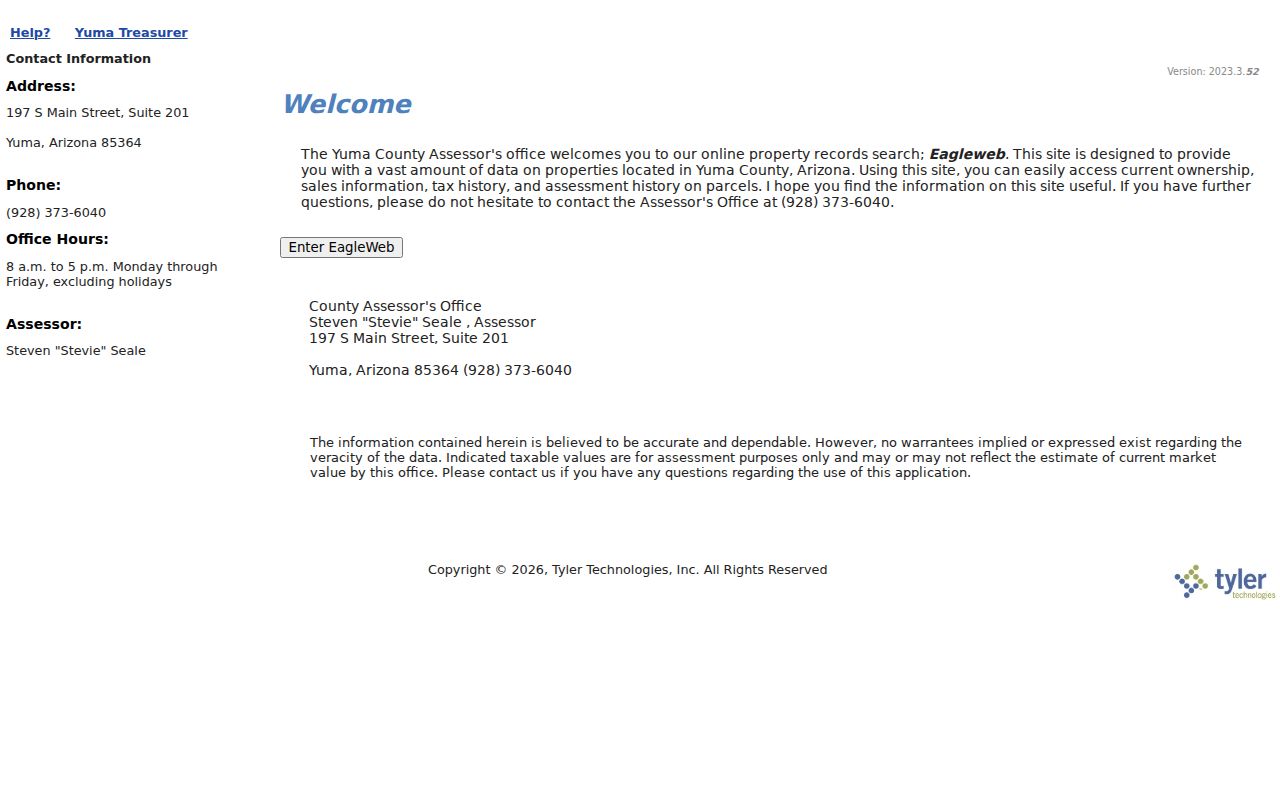
That screen is a gateway to assessment data. Carry any parcel or sales reference into Recorder records before drawing a title conclusion.
| Property field | Best use | Key caution |
|---|---|---|
| Owner name | Find parcels tied to a person or entity | Owner is not the full household |
| Situs address | Match a physical location | May differ from postal wording |
| Parcel or account | Open an exact tax account | Use the current roll year |
| Subdivision or legal | Bridge renamed or rural roads | Confirm against the deed |
| City and ZIP | Narrow stored situs strings | Not a true ZIP boundary search |
Yuma County Directory Deed Trail
The Recorder's Tyler index works like a card catalog for the instrument underneath. Search by party name, recording dates, instrument number, or document type. Older deeds may need book and page references. A grantor gives or transfers an interest, and a grantee receives it. A single deed can surface a seller, buyer, return address, parcel number, and legal description. Later corrective deeds, releases, trust instruments, or probate filings can still appear. Those filings can change what the first hit means.
Access begins at the Yuma County Records Public Access disclaimer.
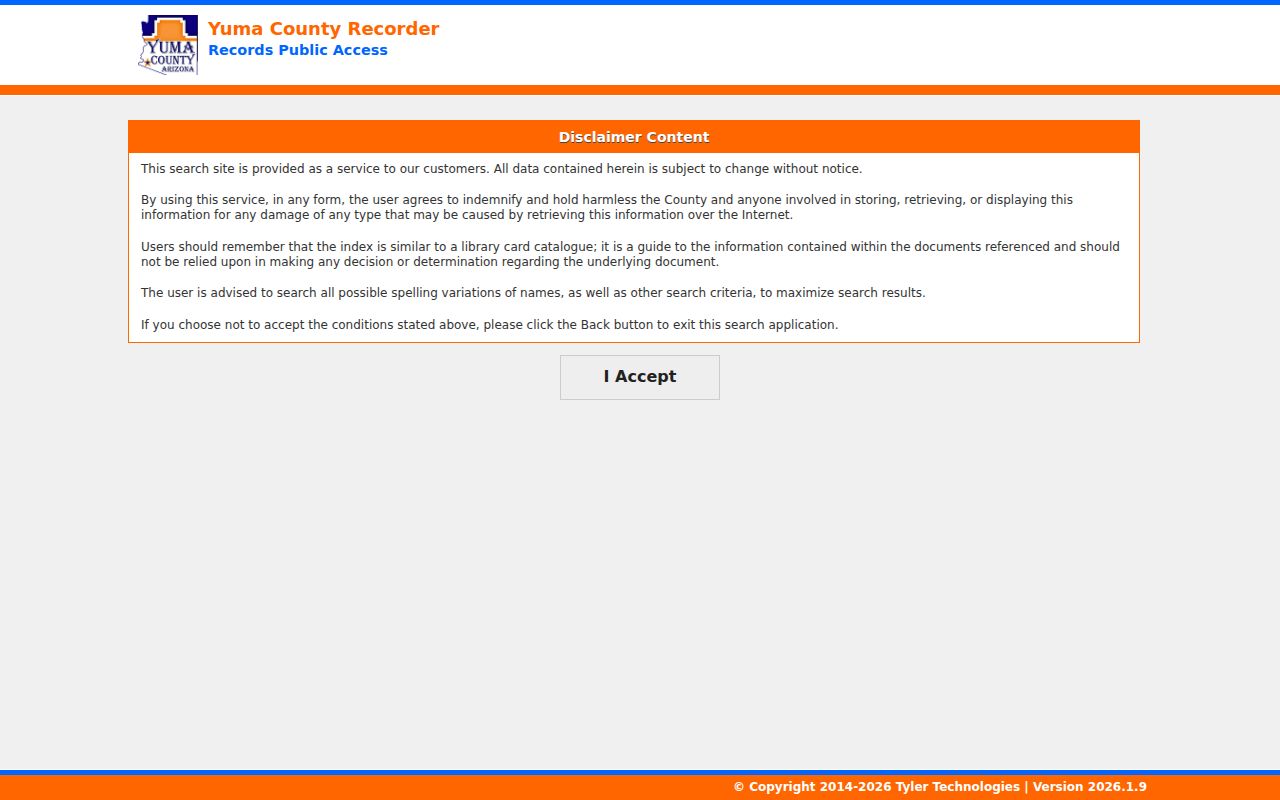
Accepting the notice opens the index. Try every reasonable spelling, then open the image itself rather than trusting the result row.
For documents without an instant image, use the official copy form or visit the counter. Copies cost $1 per page, and certification adds $3 per document. The office may take up to ten working days to locate a requested record. Documents from the 1864 through 1993 preservation range retrieve far faster when the request carries an instrument number or a docket and page.
Note: The Recorder supplies indexes and copies but does not conduct a chain of title for a requester.
Current Yuma County Directory Sources
A current Yuma County residents directory gets assembled one source at a time. Pick the roll whose official purpose fits the question, then confirm its clue somewhere else. The property roll is broad for owners. The recorder index runs deep for recorded parties. Court and regulatory indexes track events. Statute constrains voter access. Community and business lists show an affiliation, not a home address.
| Official source | Connection shown | Custodian | How to access |
|---|---|---|---|
| Assessment roll | Tax owner, mailing and situs | Yuma County Assessor | Free EagleWeb or counter |
| Recorded-document index | Party to deed, lien, plat, or release | Yuma County Recorder | Free index, mail or counter copy |
| Court case index | Named case party | Arizona courts and local clerk | Public Access, eAccess, or clerk |
| Voter service | Personal registration and districts | Yuma County Voter Services | Identity-gated portal or authorized request |
| Corporation and license records | Filed role or licensed status | Arizona agencies | Board or ACC search |
No single row establishes a whole household. A business address may be an office, a tax mailing address may be a post office box, and a court party may have left the county years ago. The one-name verification process is developed on the Yuma County resident lookup page.
Yuma County Voter Directory Limits
My.Arizona.Vote is a personal service rather than an open name directory. A Yuma County voter supplies identifying details to check registration, polling location, or districts. Ballot status can be checked too. Residence-address mode finds a polling place. It does not reveal who is registered along that street. Ballot tracking reports processing status and never discloses choices.
The official portal presents these options on its own pages.
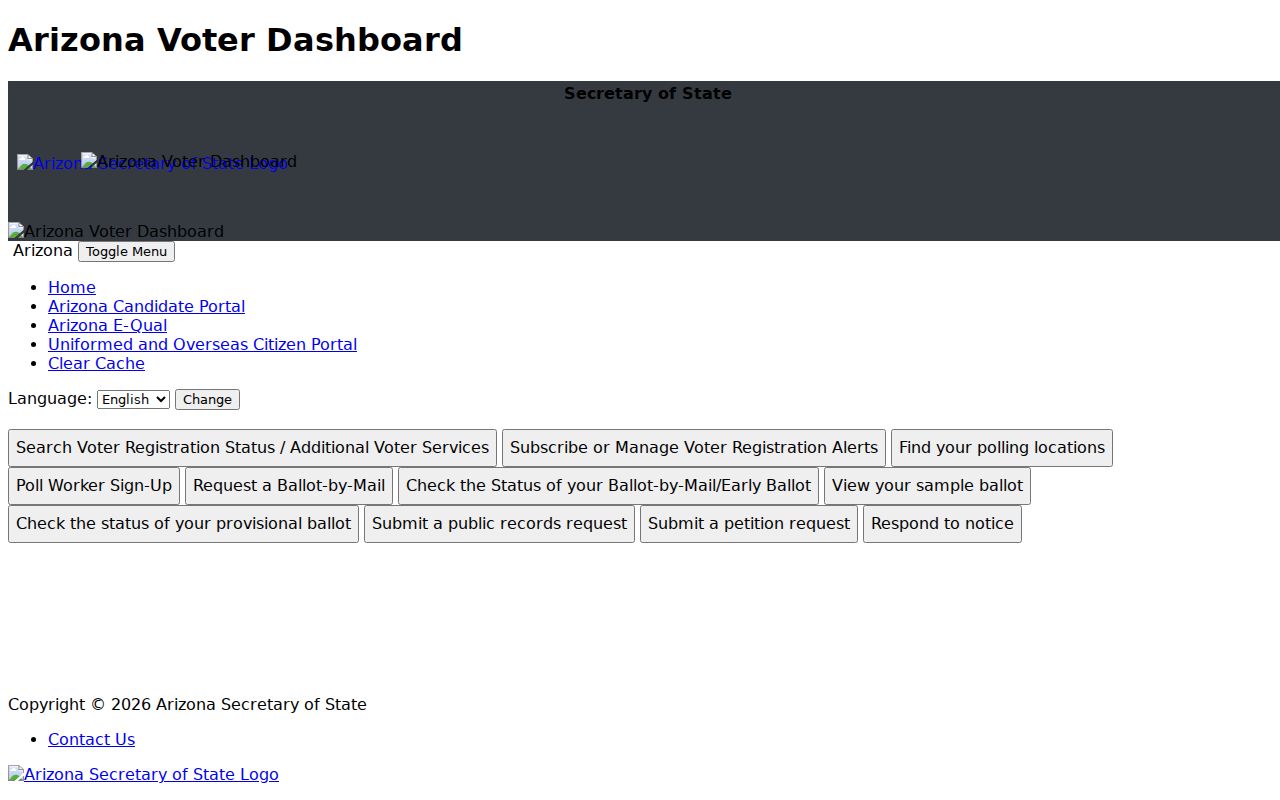
Access to the voter rolls here runs on two separate tracks. The informal tools and the formal list are different things. Certified list access goes through Voter Services and must serve an authorized purpose under A.R.S. § 16-168.
Confirm Yuma County Court Records
Party and case-number searches across most Arizona courts run through Arizona Judicial Branch Public Access. A party search works from a last or business name. It also takes a first and middle name, an optional date-of-birth filter, and a court or location. Results can display the court, case number, and filing date. Case type, parties, charges, disposition, and docket events may appear too. Treat it as an index, though. It is not the official court file, and updates arrive weekly rather than live.
Plenty of material never shows up there. Sealed matters and several protected case classes are excluded. These include protection orders, mental-health cases, and juvenile matters. Victim and witness details, plus some probate information, are left out as well. Confirm any promising hit with the Yuma County Clerk of Superior Court. Public civil and criminal documents filed from July 1, 2010 may also be available through eAccess. Municipal records follow a different path entirely. Those use the City's written request form under local retention rules.
- Docket
- The dated list of filings and events in one case.
- Index
- A finding aid that points to a record but is not the full file.
- Certified copy
- A copy authenticated by the custodian for formal use.
- Disposition
- The recorded outcome of a charge or case event.
Yuma County Vital Directory Windows
Recent birth and death certificates are identity records, not open directory entries. Eligibility rules apply. Yuma County Vital Statistics and the Arizona Department of Health Services both require proof of identity plus a relationship or legal interest before issuing certified copies. The local fee is $20. Mail applications need the listed identification or notarization, supporting proof, an original signature, and a self-addressed stamped envelope.
Historical access works differently. Under A.R.S. § 36-351, Arizona birth records open after 75 years and death records after 50 years. The official genealogy search describes birth coverage from 1855 through 1945 and death coverage from 1870 through 1970, while the statutory windows keep moving forward. Marriage licenses and divorce decrees are court records held by the Clerk, not birth-and-death records held by Vital Statistics.
Yuma County Custody Record Channels
The county publishes no stable public jail roster. For local arrest, booking, incarceration-letter, and report material, use the Yuma County Sheriff's Office records channel or Arizona VINE for custody notifications. The Sheriff quotes 15 to 20 business days for many records requests. Adult arrest records, booking photos, and incarceration letters are listed as free. Incident, case, traffic, and media copies carry stated fees. The Sheriff's records page spells out each request type.
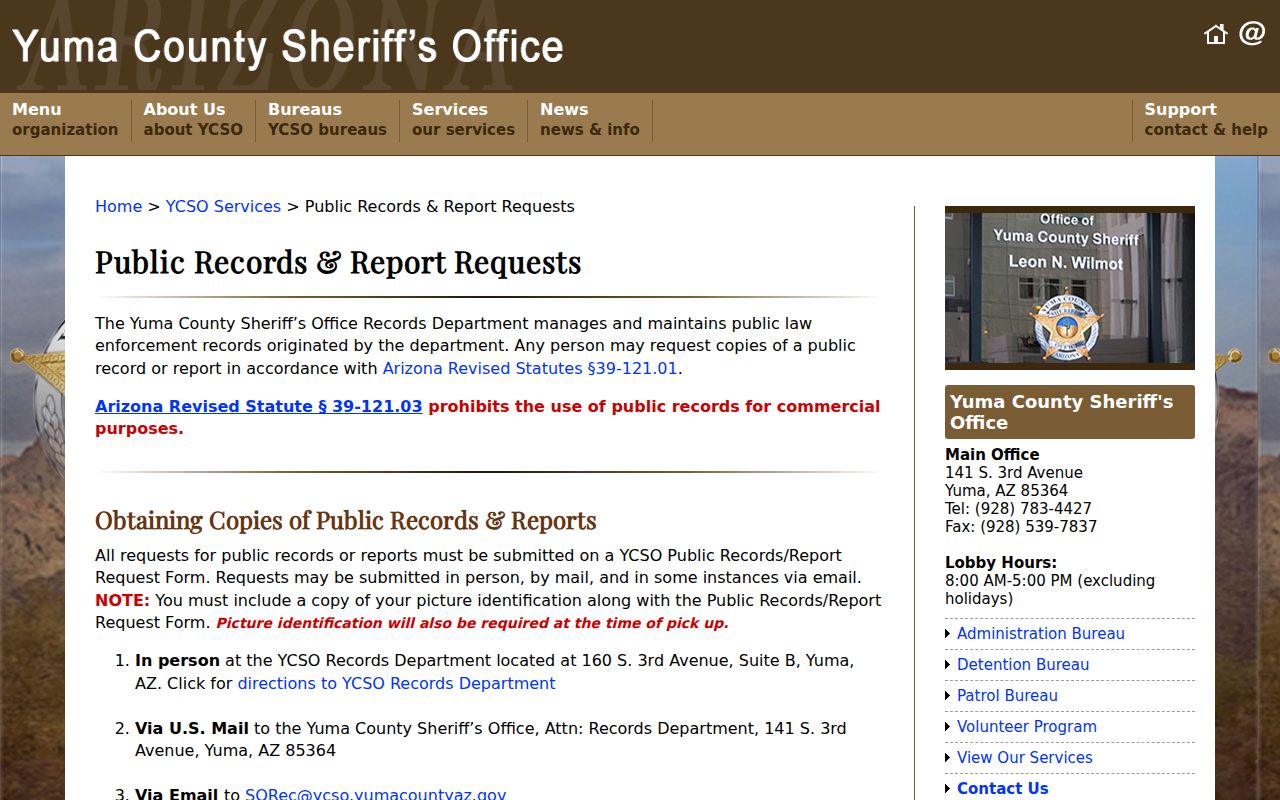
This channel is separate from the Arizona Department of Corrections inmate search. That state system tracks prison custody, not the county jail.
Use custody and registry information only for lawful personal safety or civic research. Never contact, threaten, stalk, or harass a listed person.
Route Yuma County Record Requests
Arizona Public Records Law, A.R.S. §§ 39-121 through 39-171, fills the gap. It applies when a maintained public record sits offline. The core rule is simple. Any person may inspect public records in an officer's custody during office hours. Copies must be furnished promptly. There is no fixed number of days for an ordinary request in Arizona. Privacy statutes, confidentiality rules, and state interests can still justify withholding or redaction.
Direct each request to the actual custodian. Name the record series. Spell out name variants. Give a date range plus any parcel, case, permit, document, or book-page number. Ask to inspect first, or request electronic records in the format the office itself maintains. Avoid open-ended research questions. No office will build a list it never kept. For assessment data, A.R.S. § 42-11009 adds a specific electronic-record route. It carries a ten-day copy requirement or a written reasonable-time estimate.
Yuma County Directory Identity Shifts
Older searches need more than the modern place name. The settlement incorporated as Arizona City in 1871 and became Yuma two years later. Yuma County was one of the four original Arizona Territory counties, dating to 1864. La Paz County split from its northern part at the start of 1983. An older deed, court matter, tax record, or probate file for land now in La Paz may still sit under Yuma County. Its index may carry the old name.
Directory geography also crossed political lines. Fronteer volumes treated Yuma as a regional market. They spanned Somerton, Gadsden, San Luis, Roll, the Foothills, and towns across the Colorado River in California. Some sources even fold in San Luis, Mexico. A modern city-only query can fail. If it does, try Arizona City, Yuma, and both county names. Add nearby lower-valley communities and cross-river towns.
Historical Yuma County Residents Directory
Yuma's Main Library keeps its historical shelf in the Arizona Room. The holdings there span decades of directory publishing. Verified titles run from the 1948 city-county and Cosmopolitan telephone directory onward. Later volumes include the 1949-1950 Yuma-Somerton City Directory, Johnson and Arizona Directory titles, Polk material, and Fronteer regional phone books. InfoUSA's address-first Cross+search reverse directories round out the shelf. One consolidated catalog record covers 108 copies or volumes. It does not, however, give a complete annual run. Special Collections can confirm a year before you travel.
A criss-cross directory flips the usual lookup. Entries appear by street address or phone number instead of by name. That makes it a strong tool for tracing past subscribers. It proves residency, never ownership. The full shelf, its publishers, and call numbers appear in the Yuma County city directory. It also explains how to read the volumes.
The Arizona Room offers more than directories. Its newspaper microfilm runs from 1872 through 2011. The collection also includes Arizona census reels, genealogy databases, and reference help. Ancestry Library Edition works in-library only; other products vary by card and location. OCR often misses Spanish compound surnames or damaged type. Manual microfilm around a known date stays a sound fallback for any residents directory search in Yuma County.
Compare Yuma County Resident Evidence
No single source in Yuma County deserves the last word on a resident. A deed records a land transaction. A printed directory captures only the contact a publisher observed or was supplied. A census fixes a household to one enumeration. A newspaper logs life events. A permit dates work with an applicant or contractor named. Each record keeps a different clock and a different blind spot. Two-source confirmation is what turns a directory lead into solid resident evidence.
| Evidence | Strongest conclusion | What it cannot prove alone |
|---|---|---|
| Assessor parcel | Named tax owner and parcel facts | Every resident at the address |
| Recorded deed | Parties and legal land description | Day-to-day occupancy |
| City directory | Listed contact in an edition | Complete population coverage |
| Census schedule | Household at the census date | Residence between censuses |
| Obituary and probate | Family clues and estate roles | A current address without more proof |
Commercial compiled directories can supply a lead. But they lag corrections and sometimes merge people with similar names. Return to the named custodian in Yuma County, inspect the source record, and keep protected addresses private.