
Yuma County Directory Shelves
The strongest Yuma County city directory search begins with the edition, publisher, and call number. The Yuma County Library District catalog verifies several distinct series. Some records name a single issue. Others gather many physical volumes under one catalog entry, so a catalog date must not be treated as the full run. Ask staff to confirm the actual title page and year before making a trip.
| Collection | Years or anchor | Where held | Access |
|---|---|---|---|
| Yuma City-county Directory and Cosmopolitan Telephone Directory | 1948 onward | Yuma County Library District | Physical catalog holding |
| Yuma-Somerton City Directory, second edition | 1949-1950 | Call 384.6025 .Y95 Y95Y | Physical volume |
| YUMA CITY DIRECTORY consolidated record | 1988-89 catalog anchor | Call 917.9171 Y95 1988-89 | 108 copies or volumes; confirm a year |
| Yuma County Arizona Polk City Directory | Title dated 1999; call number says 1997 | Call 917.9171 Y952 1997 | Three copies; inspect title pages |
| Yuma, Arizona City Directory | Exact issues not exposed | Johnson Publishing, call 384.6025 .Y95 J68 | Physical catalog holding |
| Cross+search Reverse Phone Directory | 2006 onward; 2018 identified | SPEC AZ 917.9171 C7586 2018 | Seventeen copies; some noncirculating |
The research did not establish every year behind the consolidated record or a final print year. That gap matters. A Yuma County city directory is best cited by exact title, edition, page, and publisher, not by a broad catalog range. The Arizona Directory general volume and Fronteer and Universal telephone series also warrant a title search when the main record misses the target place.
Yuma County City Directory Desk
The Arizona Room on the Main Library's second floor is the local access point for special collections. It is at 2951 S. 21st Drive in Yuma. Reference staff can be reached at (928) 314-2463 or SpecialCollections@yumalibrary.org. Its holdings include Genealogical Society of Yuma material, regional books, newspaper microfilm, and Arizona census reels for 1880, 1910, and 1920.
Start with the catalog, then contact staff with a name, likely year, and title. Ask whether the volume is available, noncirculating, or grouped beneath a larger record. In-person inspection is the key access channel because no authoritative open scan of an actual local directory page was found. Licensed databases provide a second route. Ancestry Library Edition is in-library only, while Fold3, HeritageQuest, and HeritageHub availability depends on the library's current access rules.
The library genealogy database page shows the current research entry points.
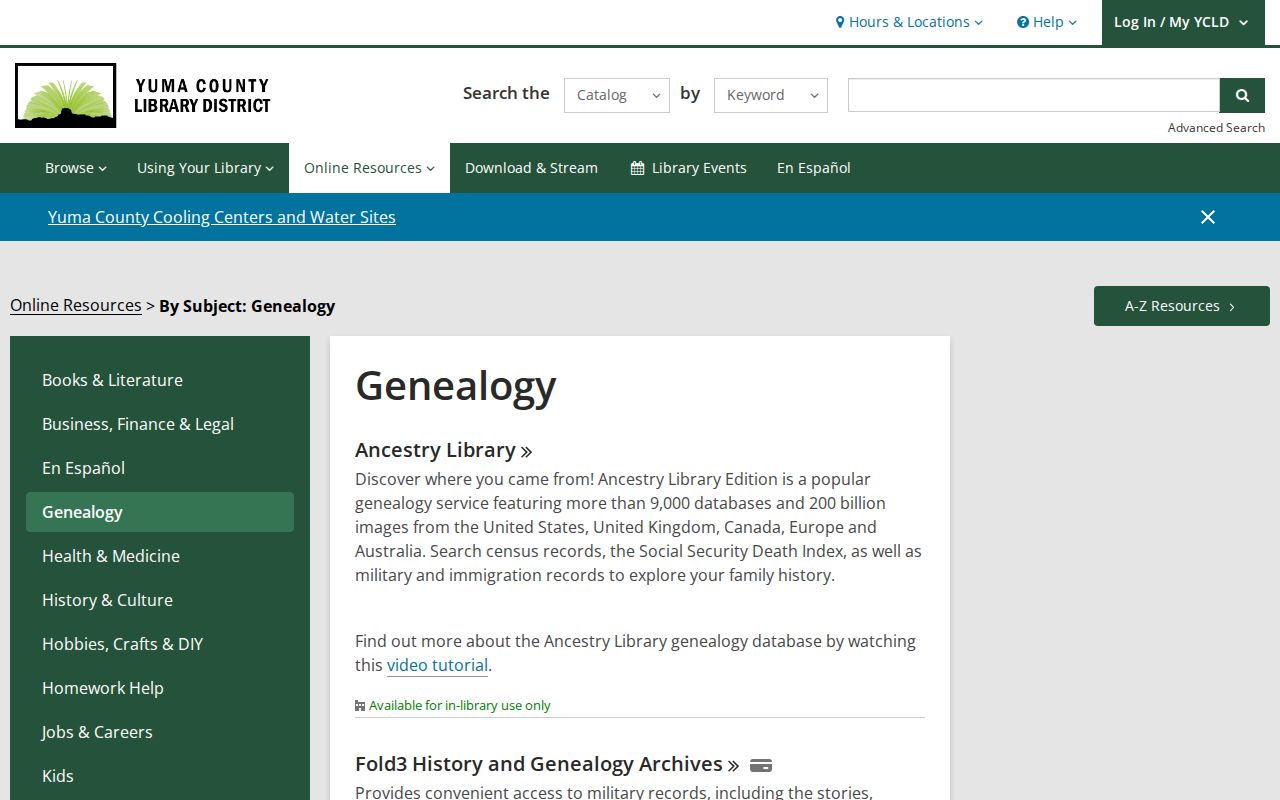
This screen helps separate resources that work remotely from those requiring a library card or a visit to the building.
Yuma City Directory Date Puzzle
One Polk record carries a small but useful warning. The title says 1999, while its call number ends in 1997. Neither date should silently replace the other. Record both, then inspect the cover, title page, copyright page, and any publisher note. A catalog entry describes an item, but the volume itself controls the citation.
This quirk also shows why the 108-copy or volume record needs care. It does not prove 108 continuous annual editions. It may group copies, issues, or related holdings. Arizona Room staff can check the shelf and identify the exact Yuma County city directories available for a narrow date range.
The live Yuma directory catalog search is the best place to preserve the current title and availability display.
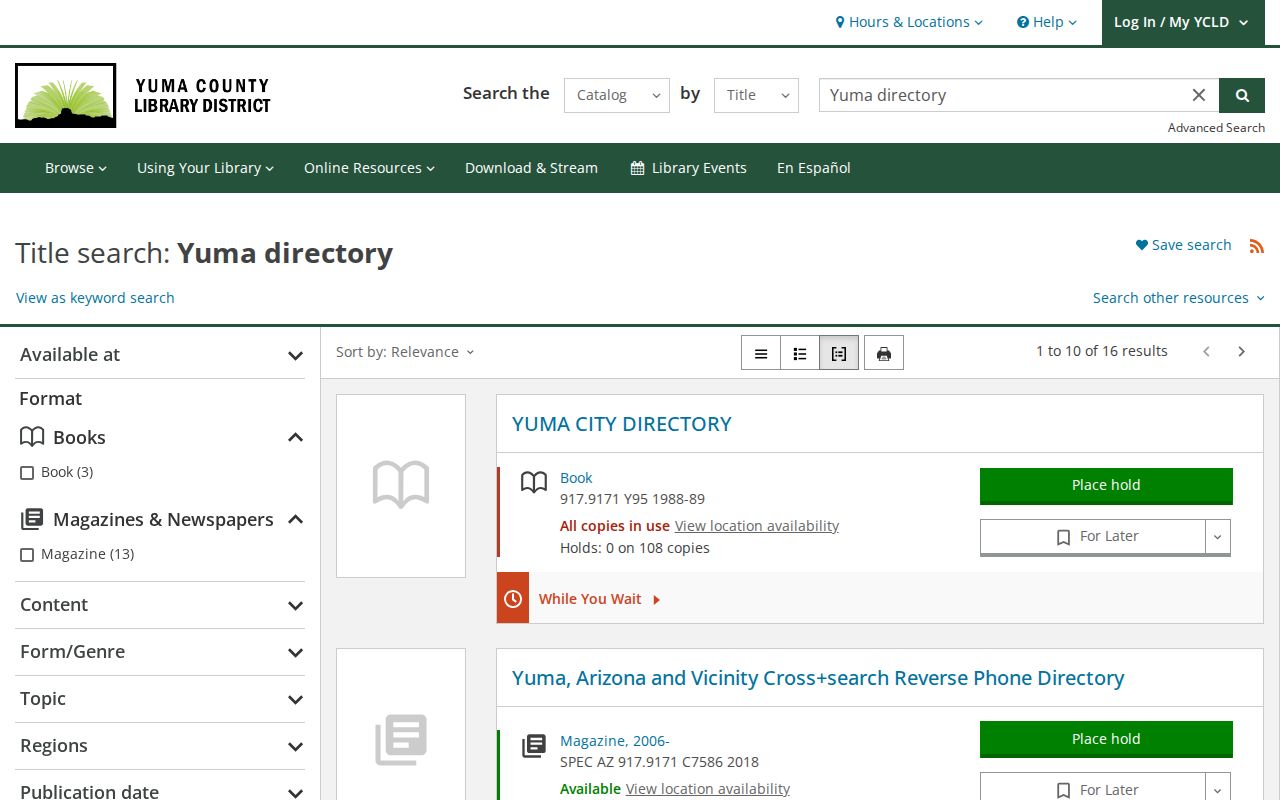
The catalog result is a locator. The physical title page remains the source for an edition's date and publisher.
Note: Photograph or transcribe the title page and abbreviation key before recording any household entry from a Yuma volume.
Decode Yuma County Directory Entries
No authoritative digitized sample page was available for inspection, so a local entry format cannot be invented. Publishers change symbols and abbreviations. When a volume is in hand, capture the fields below only as they appear, and use that edition's key to explain them.
| Identity | Surname, given name, and middle initial as printed |
|---|---|
| Household clue | Spouse or widow notation, if the publisher supplies one |
| Work clue | Occupation and employer, if listed |
| Place clue | Residence, business address, or telephone listing |
| Status mark | Owner or renter symbol only when the local key defines it |
| Source control | Exact edition, page, and abbreviation key |
A spouse name or widow notation is a clue, not a vital record. A telephone subscriber may differ from the owner. The directory's canvass date may also predate publication, so a move can appear one issue late.
- Criss-cross directory
- An address-first or phone-first section that reverses the usual name order.
- Householder index
- A publisher's list of people associated with addresses, subject to that volume's inclusion rules.
- Abbreviation key
- The edition-specific legend that defines short forms, occupations, and status marks.
- Publisher-observed contact
- A listing gathered for that edition, not proof of title or a full household roster.
Yuma County Directory Crossings
A Yuma city directory can reach beyond a city boundary. Fronteer's metro telephone directory names Yuma, Somerton, Gadsden, Roll, Foothills, Fishers Landing, Martinez Lake, and other lower-valley places. It also crosses the Colorado River to Winterhaven, Andrade, Bard, and Felicity in California. A Universal series even names San Luis, Mexico.
That reach reflects Yuma County's border, farm, military, railroad, and river ties. It also creates false negatives when a researcher searches only “Yuma.” Try the community name, a cross-river place, and both forms of a Spanish compound surname. Seasonal labor and winter visitors may appear briefly, while migrant workers may be absent from standard lists.
Yuma Directories Meet Maps
Seven verified Yuma Sanborn fire-insurance editions create building checkpoints from 1893 through 1948: 1893, 1896, 1901, 1911, 1917, 1927, and 1948. Somerton adds 1920 and 1926 sheets. The Library of Congress Yuma Sanborn search supplies remote access. These maps show footprints, materials, street numbers, and use. They do not name occupants.
Pair a map with a directory entry to test whether an address and structure line up. Then use the Arizona Room newspaper reels for events between editions. The collection spans 1872-2011 overall, with Early Newspapers grouped from 1859-1936. Title runs shift from Yuma Daily Sun to The Sun and then The Yuma Sun. Search each title, and browse microfilm near a known date when optical character recognition misses a name.
Directories list contact. Deeds establish title. Census schedules show a dated household, while newspapers report life events. No one source substitutes for the rest.
Earlier Names in Yuma Directories
Place history changes the catalog trail. The settlement incorporated as Arizona City in 1871 and took the name Yuma in 1873. Yuma County began as one of Arizona Territory's four original counties in 1864. La Paz County split from its northern part on January 1, 1983. An early family, land, probate, or newspaper trail may therefore sit under an older place name or a former county boundary.
| Checkpoint | Search consequence |
|---|---|
| 1864 county organization | Territorial records can predate later local series. |
| 1871 Arizona City incorporation | Use Arizona City in early catalogs and newspapers. |
| 1873 name changed to Yuma | Continue the same person trail under the new place name. |
| 1948 city-county directory anchor | Begin the verified local directory sequence. |
| 1983 La Paz County split | Older Yuma records may concern places now in La Paz County. |
The Arizona Historical Society library and archives and the Arizona State Archives are fallback repositories for manuscripts, photographs, and transferred records beyond the library shelf. The Arizona Room remains the first local contact for a year-specific directory request.
The Arizona Room access page shows the local collection setting.
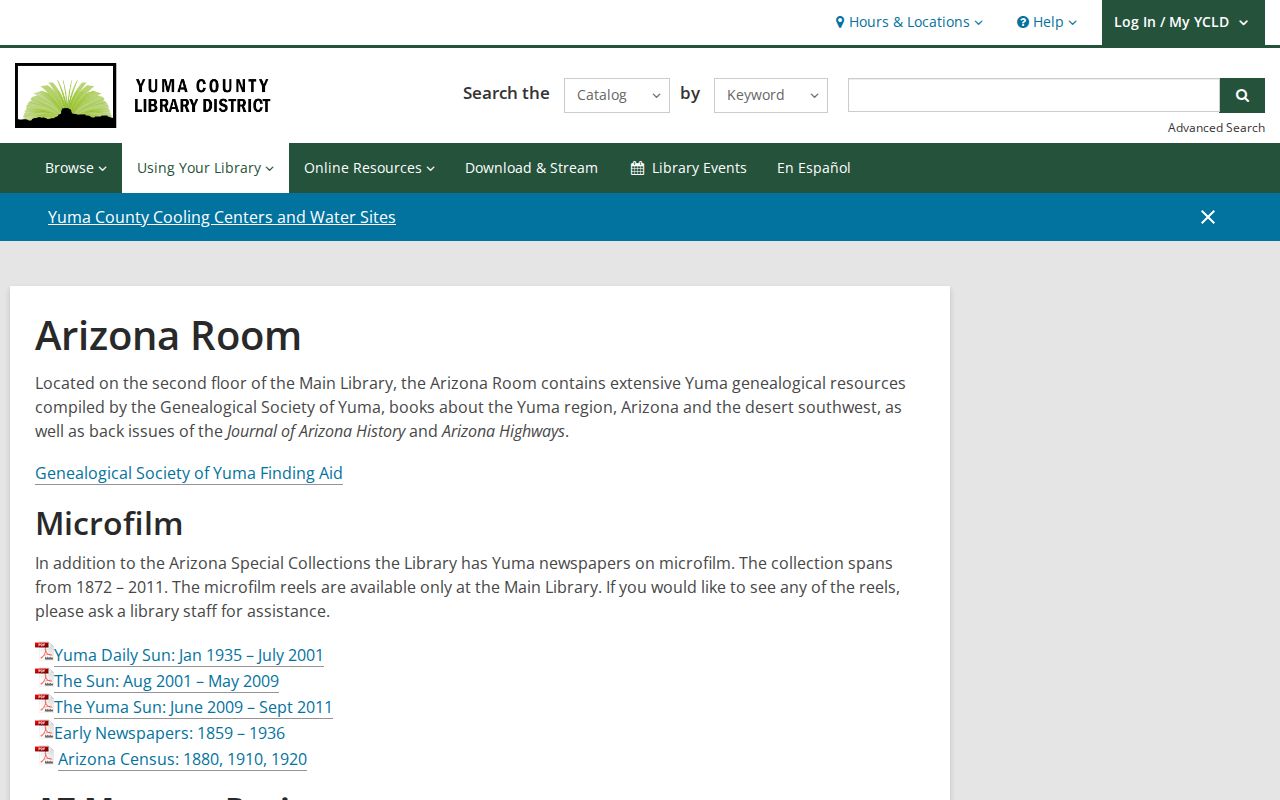
This local collection point connects printed city directories with newspapers, census reels, and Genealogical Society of Yuma material.
Trace Yuma County Directory Families
Family history works best as a sequence, not a single hit. Start with a known event and the nearest directory year. Keep the spelling exactly as printed, but repeat the search with paternal, compound, hyphenated, and separated surname forms. If the target disappears, do not assume death or departure until another source supports it.
- Confirm the exact title, edition, page, and abbreviation key for the first Yuma County city directory entry.
- Check the adjacent editions in both directions. Record each change in spouse, work, phone, and address.
- Use a reverse section to test the address and nearby subscribers. Treat it as listed contact, not ownership.
- Pair the trail with public census schedules through 1950 and with Sanborn sheets for the matching period.
- Search the correct newspaper title, obituary material, probate files, and deeds to explain a gap or move.
The 1995-onward Yuma High School Alumni Directory can help with school-era identity or a name change. Arizona Memory Project contributions and migrant-worker material can recover people whom standard city directories undercount. For a modern address-first chain, the Yuma County street directory shifts from historical listings to parcel and deed evidence.
A missing listing has several possible causes: a move, an unlisted telephone, publication lag, temporary residence, or the publisher's geographic limits. The next dated source should decide which explanation fits.
Keep a research log for each pass. Note the searched surname form, edition, result, nearby names, and any page that could not be checked. Then compare the address against the Assessor, a deed, or a census schedule appropriate to that date. HeritageHub obituaries and death notices extend from 1704 to the present through the library's licensed resources, but access terms may change. NewspaperARCHIVE.com, Arizona News Sources, ProQuest, and the local newspaper databases offer more routes. When text search fails, staff-assisted reel browsing near a known event can recover a faint or misspelled name.