
Yuma County Lookup Record Map
A resident lookup in Yuma County should start with the record that answers the narrow question. EagleWeb identifies a parcel's assessed owner. A Recorder entry identifies a party to a filed instrument. A court hit ties a name to a case, while a license record ties a person to a board credential. These facts can support one another, but they are not interchangeable. A mailing address can point away from the parcel, and a business address can belong to an agent.
| Record | Fact it can confirm | Official source | Access path |
|---|---|---|---|
| Assessment roll | Named tax owner, situs, mailing address, parcel | Yuma County Assessor EagleWeb | Free web search or Assessor counter |
| Recorded documents | Party role in a deed, lien, release, plat, or affidavit | Recorder Records Public Access | Index, counter, or copy request |
| Court cases | Name and role connected to a participating Arizona case | Arizona Judicial Branch Public Access | Free index, then local clerk |
| Vital records | Birth, death, marriage, or divorce event | County, ADHS, or Superior Court Clerk | Historical search or eligible copy request |
| Filed credentials | License status or business role | Arizona license directory and ACC eCorp | Board or entity search |
| Unclaimed property | Name tied to property reported by a holder | Arizona Department of Revenue | Free search; proof needed to claim |
Start with the most stable identifier available. Parcel numbers bridge Assessor and Recorder records. Case numbers bridge an online docket and the clerk file. A license or entity number separates two people who share a name. Yuma County has many compound surnames and name variants, so a city plus a common surname is not enough for a sound match.
Confirm Yuma Resident Court Matches
Arizona Public Access offers a Party Search after CAPTCHA. The fields include Last Name or Business Name, First Name, Middle Name, date of birth filter, and court or location. Results can show court, case number, case title or party, filing date, and filing type. Detail can add party roles, charges, disposition, and docket events. The index covers most, but not all, Arizona courts and updates on a weekly lag.
A court result is an association, not proof of fault. Read the status and disposition. Protection-order, mental-health, victim or witness, juvenile, and some probate information can be excluded. Sealed material will not appear. When the resident lookup produces a likely match, use the case number with the Yuma County Clerk of Superior Court. The clerk at 250 W. 2nd Street keeps the official local file and can explain inspection, copy, research, and certification channels.
| Result field | How to read it |
|---|---|
| Court and case number | The key for retrieving the official file |
| Party and role | The name's connection to the matter, not a finding |
| Filed and event dates | The sequence of the case, not always the date of the underlying event |
| Status and disposition | Whether and how the matter ended, if shown |
| Charge or count | An allegation that must be read with its disposition |
Arizona Superior Court eAccess can extend the resident lookup beyond docket metadata to public civil and criminal documents filed from July 1, 2010. An account and payment may be required. The screen below shows the official eAccess entry, which should be used after a case number or solid party match is known.
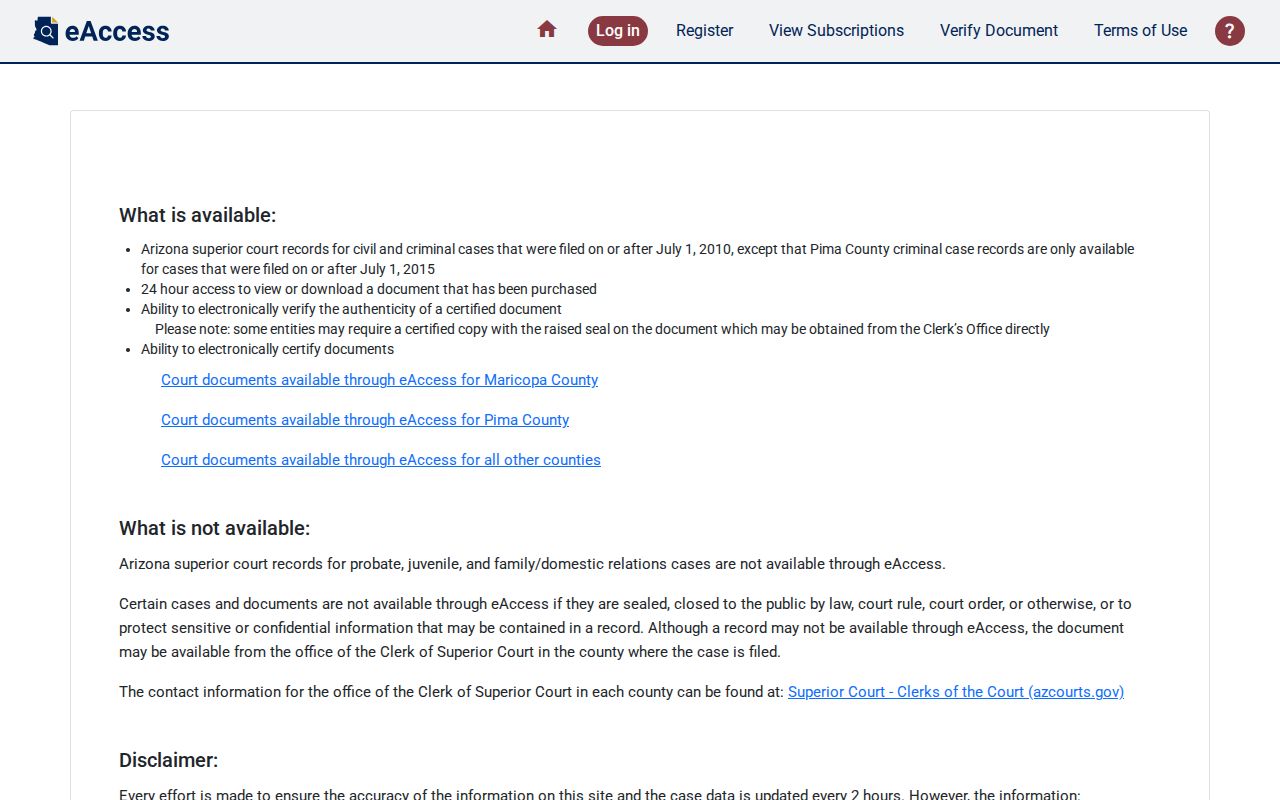
The document portal adds context, but the local clerk remains the source for the official and certified Yuma County record.
Build a Yuma Resident Match
A strong Yuma County resident lookup uses two independent records and keeps each source within its limits. Begin with a broad name search. Normalize middle initials, suffixes, married names, compound Hispanic surnames, and likely spelling errors. Next, narrow the result with a date or record number. Finally, compare a second source that arose for a different purpose.
- Anchor the name to a stable clue. Use a parcel and legal description, a case number, a license number, or an entity ID.
- Check chronology. A filing address from years ago cannot confirm a present address, and a deed's recording date may differ from its execution date.
- Open the underlying record. An index row is a catalog pointer. Read the deed, docket event, filing image, or certificate image when access permits.
- Compare a second official source. Make sure the name form, dates, location, and role fit without forcing two records together.
- Ask the custodian for a certified copy only when that level of proof is needed.
- Docket
- The dated list of filings, hearings, and actions in a court case.
- Index versus image
- An index points to a record. The image contains the filed document and often supplies the facts needed to interpret the hit.
- Certified copy
- A copy authenticated by the office that holds the original record.
- Situs address
- The physical location assigned to a taxable parcel, distinct from the owner's tax-mail address.
Never merge entries just because they share one address. Yuma County records can reflect multigenerational families, post office boxes, trusts, statutory agents, or a mailing service. Two-source matching is slower, but it avoids turning a useful clue into a false identity.
Yuma Historical Vital Lookup
Arizona draws a sharp line between recent certificates and historical genealogy records. Under A.R.S. § 36-351, birth certificates become public after 75 years and death certificates after 50 years. The official genealogy search currently states coverage for births from 1855 through 1945 and deaths from 1870 through 1970. These published endpoints can move as records age into the public window.
Search Arizona's historical birth and death records by name and date variants. The official interface pictured below gives a direct genealogy route for a Yuma County resident lookup, while recent certificates stay subject to identity, relationship, and legal-interest rules.
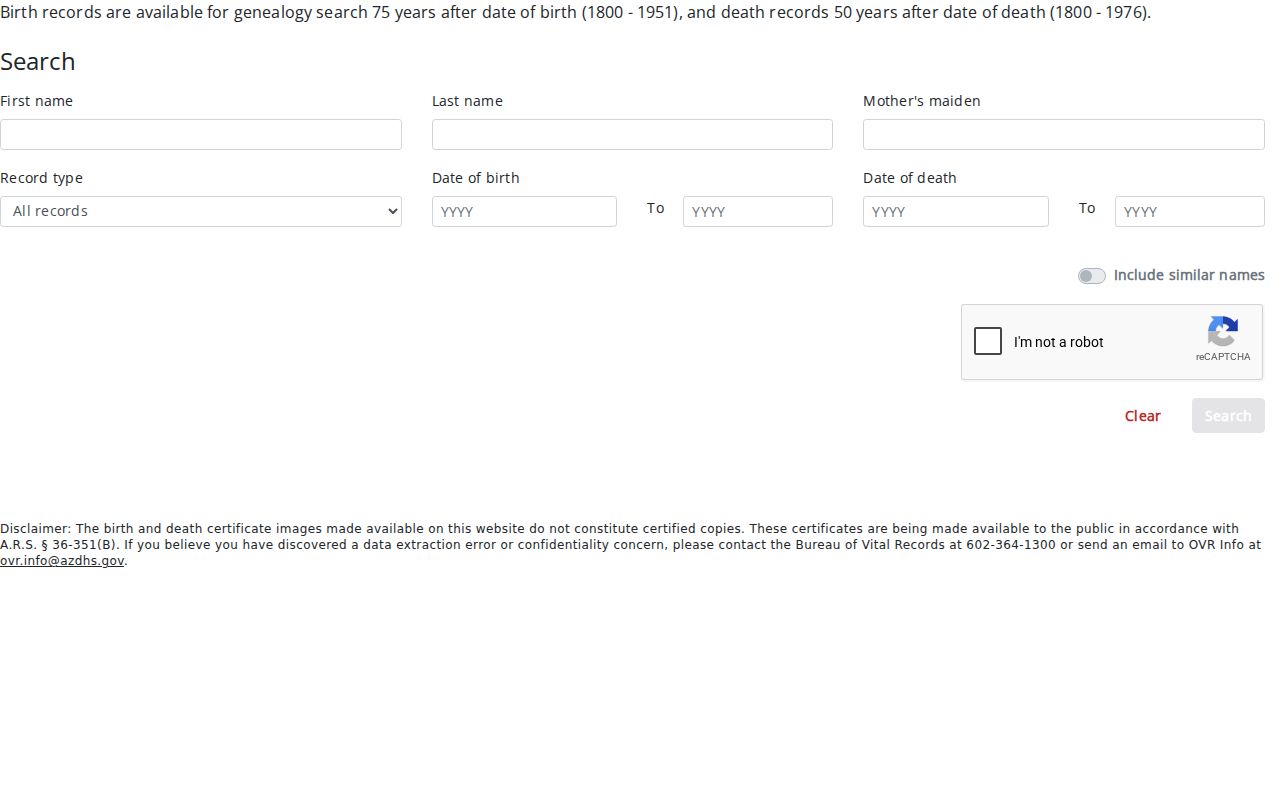
A historical image may name parents, an event place, and an informant. Check those facts against an obituary, probate case, or directory entry rather than treating a same-name certificate as final.
For recent Yuma County births and deaths, the county Vital Statistics office and ADHS require the stated eligibility proof, identification or notarization, signature, fee, and mailing items. Marriage licenses and divorce decrees belong with the Clerk of Superior Court. A marriage license is not proof that a ceremony was completed until the returned license became a court record.
Trace Yuma Resident Heirs
An heir search is one of the clearest human uses for a resident lookup. Start with a death record or obituary. Then search the Superior Court probate docket for the decedent, personal representative, and any public heir references. A recorded distribution deed can connect the probate result to the parcel. Each source adds a different part of the chain.
Arizona Unclaimed Property offers another official clue when a name is tied to assets reported by a holder. Open the Arizona Unclaimed Property search rather than paying a recovery pitch for the same starting search.
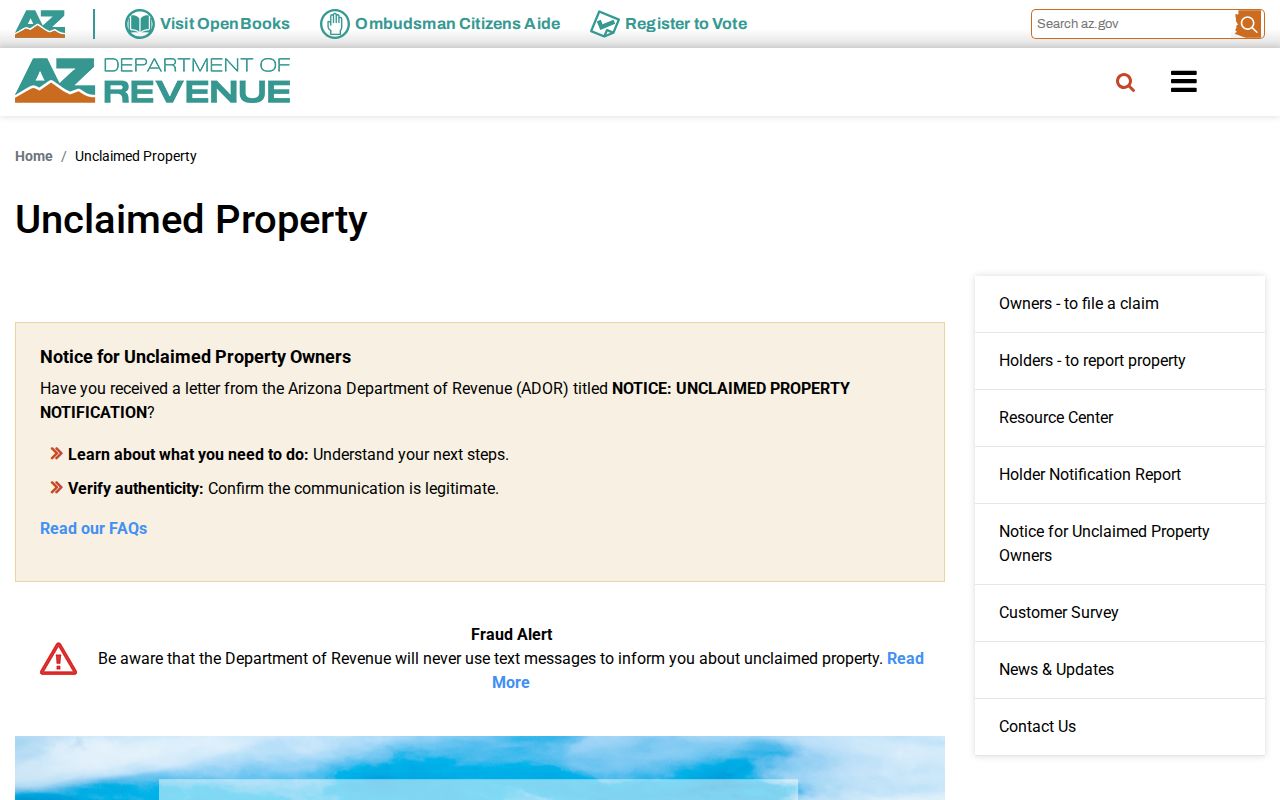
The public hit does not disclose the claimant's full proof file. It points to a claim process, while probate and recorded instruments can establish the family or property trail.
When the trail reaches an old Yuma address, ownership alone is not occupancy. The Yuma County city directory collections can supply era-specific household clues, alumni material, and newspaper context without turning an assessment entry into a claim about every resident.
Confirm Yuma Resident Roles
Professional and business records are useful for distinguishing a person, especially when the filing includes a unique number. Arizona routes occupations to separate boards, so the statewide directory is a gateway rather than one uniform database. Visible fields and discipline rules depend on the issuing board.
Choose the official Arizona license lookup for the relevant board. The captured directory below shows that official starting point for a Yuma County lookup.
A current status and license number can separate names, but a practice address does not by itself prove a home address.
The Arizona Corporation Commission's eCorp search can use entity name, statutory agent name, principal name, entity ID, entity type, status, name type, and county. Results may show formation dates, roles, known-place addresses, and filing images. A statutory agent accepts legal service and may be a commercial service. Read the role and date before linking a filed address to a Yuma County resident.
Restricted Yuma Resident Sources
Some official tools are public but serve a narrow safety or government purpose. The Arizona DPS registry supports name, address, and geographic searches and warns against misuse. It is not a general resident roll. Review the Arizona DPS official registry information before using that search.
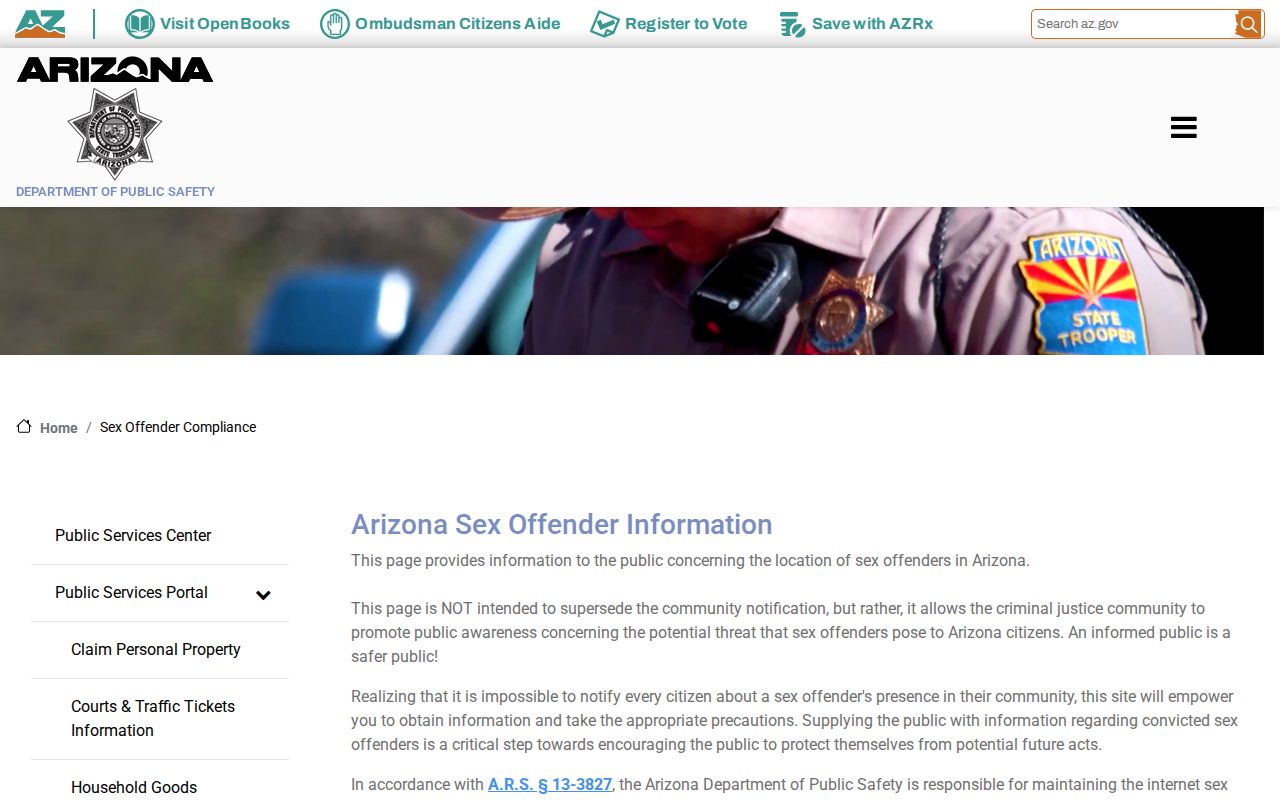
The image marks the state source, but any result still needs identity care and must never be used to threaten or harass a person.
Voter information is also purpose-limited. My.Arizona.Vote is an identity-gated personal service. Its residence-address mode finds a polling place, not names along a street. A formal Yuma County voter-file request requires an authorized statutory purpose under A.R.S. § 16-168. Sensitive registration fields, protected voters, and Address Confidentiality Program participants remain shielded.
Request Missing Yuma Records
Portal silence is not proof that no record exists. Arizona Public Records Law, A.R.S. §§ 39-121 through 39-171, supplies the fallback. Send a narrow request to the office that keeps the record. State the record series, all name variants, a date range, and any parcel, case, document, or license number. Ask to inspect the record or receive it in its maintained electronic format.
Court records have several channels. Public Access supplies participating-court metadata, eAccess supplies some post-2010 Superior Court documents, the clerk counter reaches local files, and a written Municipal Court form covers city matters. Historical court material may require a clerk archive inquiry or the Arizona State Archives. The same channel logic applies to vital records: historical images use the genealogy search, recent certificates use an eligible application, and marriage or divorce records go to the clerk.
Corrections also belong with the custodian. Contact the Assessor for parcel data, Recorder for indexing or statutory redaction, Clerk for docket issues, election staff for voter data, and the issuing board for a license. Preserve the record number and identify the exact error.
Note: A precise Yuma County resident lookup request is easier to locate and less likely to demand research the office does not perform.
Yuma Resident Lookup Boundaries
Arizona public access has real privacy edges. The Address Confidentiality Program provides a substitute government address and mail forwarding for qualifying survivors. Recorder, Assessor, Treasurer, and voter redaction laws add protection in defined cases. Recent vital records require statutory eligibility. DMV personal information and private utility, delivery, and membership data are not open resident sources.
Commercial compilations can lag corrections and blend same-name people. Treat such output only as a clue, then return to the official custodian. A record should be read for the fact it actually establishes. An assessed owner is not a full household, a court filing is not a disposition, and an entity role is not proof of residence.
Lawful use. Use a Yuma County resident lookup only for lawful personal research. Arizona stalking and harassment laws prohibit using records to watch, threaten, or intimidate another person.